Thoughts on Physical Social Networking

June 18, 2008 · 22 comments

Go back to 1998 and remember when you had your shiny new Palm III PDA. It was the first of its kind to sport an infrared port. At the time, the killer feature of the Palm infrared port was not turning off walls of televisions at Best Buy but rather exchanging vCards with other Palm users – wireless business cards if you will. That never really took off though. A decade later and people are trying to give that concept another whirl, with a twist.

Hello My Name is E is the name of the site and they proclaim it is future of social networking.

Hello My Name Is E

The service revolves around users toting around a small device that when paired with another user’s such device, exchanges contact information. This is where that whole wireless business card notion and reminiscence about the first Palm PDAs comes in.

E is a service and a device which give you the possibility to exchange contact information with a simple gesture. Hold two devices together for less than a second and they exchange contact information. Once you synchronize the device to a PC or Mac, the information you’ve collected is uploaded to the E service, where you can add your contacts directly to online services like LinkedIn or Facebook.

When the device is later synced with the service, it allows users to easily keep tabs on who they connected with and further manage their contacts on social networking sites; so it’s not so much physical social networking as it is social networking facilitated by a physical device.
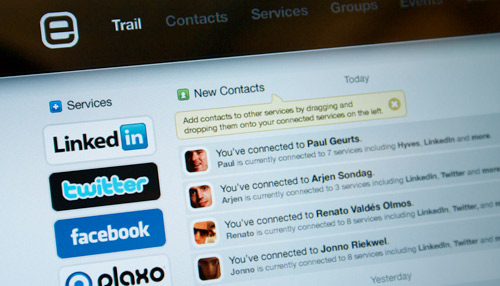
Hello My Name Is E Interface

In a time when social networks are slowly embracing OpenSocial, E seems like a perfect in-the-meantime service. It definitely solves a problem I have dealt with when attending conferences and other events where there is a business card overflow issue.
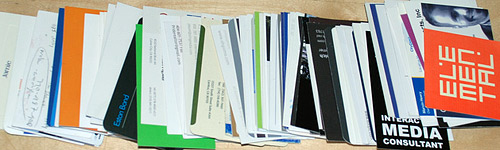
Business Card Overflow

The typical new contact workflow for most people might go something like emailing them and adding them on LinkedIn or Facebook. The problem is that with business cards that is an entirely manual process and usually involves Googling to find their Twitter account or personal blog. E gives you more than that, and in a digital format so you can add the contact to whatever services you wish, instantly.

The problem comes with adoption though. Sure this will be a boon for the very small percentage of Internet users that go offline and attend conferences, but how easy is it to make a few million E devices and ship them out to every user? Is it targeted at just tech-savvy conference-going networkers or is it also aimed at anyone that currently uses a business card? Hopefully these issues will solve themselves as E starts opening its doors to the public.

I wonder if something like E could be made with technology based around people taking cameraphone images of a special user identifier keychain or card and having the service use a sort of OCR to process the pictures. It would be cheaper than having to manufacture all those E devices, which the user might be charged for, although no public statement has been made about that.

If E was here and now, would you sign up and use it?

{ 2 trackbacks }

Poken is Touch and Connect Social Networking  »TechAddress
July 18, 2008 at 2:39 pm
Jay G.'s weblog
October 13, 2008 at 4:37 am

{ 20 comments… read them below or add one }

1 Vassilis June 18, 2008 at 4:31 pm

It looks nice, but I can already see a couple of serious “bugs”. Its hardware based nature means it will be either a success (even at small “niche” markets) or a failure altogether, since there must be many people around carrying this device. The other big drawback is that you must sync and probably go online to see your new contacts details. You could as well search online your contact’s OpenID and get all the details (and maybe even more details, after his approval).

So, yes, I would give it a shot, since this product won’t be around for long…

Reply   More from author

2 skipc June 18, 2008 at 7:21 pm

a non-starter. the last thing one needs is yet another device to carry. best…skip

Reply

3 Rahul Gaitonde June 19, 2008 at 12:08 am

My guess is that a simple, intuitive-enough application on a mobile phone would trump E.

The app could be SMS-based (text msg), Infrared-, Bluetooth- or Wifi- based, but (to extend skipc’s comment) it’d obviate the need for an additional device.

That said, your article does bring up the still-unsolved issue of being able to elegantly sync contact information between a mobile device (Symbian, Win Mobile, OS X), web-based email (Gmail, Y!), desktop email (Outlook, Notes, Mail, T’bird), and web-based services (F’book, Linkedin et al).

Reply   More from author

4 Anonymous June 19, 2008 at 1:35 am

The need for this is very obvious, but as others have said, nobody wants to carry around another device. My pockets are conspicuous enough as it is.

What we need is for the iPhone 3.0 to have the exact same capabilities. I’d buy that. (Who wouldn’t?) To answer the question, if E was here and now, I’d be tempted to buy it; but I wouldn’t, because nobody else I meet would have one. I’m not cool enough to go to conferences. Yet.

Reply   More from author

5 Thomas M June 19, 2008 at 2:40 am

Is that a Hugh Mcleod business card lurking at the back there? Which cartoon is it?

Reply

6 Nils Geylen June 19, 2008 at 8:06 am

What strikes / bothers me is that this thing was known as Evo over a year back (http://www.hellomynameise.com/evo.html – now nonexistent). However, not a lot seems to have changed since, except for the name. It can’t take that long to build something that sends data to wireless devices can it?

I second the commenters here that a mobile phone / PDA app could do this just as well, but that I’d also love to try it. We need something beyond the business or vCard soon.

Reply   More from author

7 JW3 June 19, 2008 at 10:30 am

Seems somewhat similar to Tag6 from Startup Riot.

Why don’t they just give everyone an “online social security type number” that does the same thing? This way, I don’t have to use the hardware (or find someone else with it)

Reply   More from author

8 Haye June 19, 2008 at 11:22 am

I actually had the pleasure to test one of the early prototypes and I really have to say that the product is a gem. The gestural based connection works really intuitively (with visual and tactile feedback), and the service integration is fabulous. Think Plaxo, but with an amazing UI. The only problem they might encounter is how to get as many devices to as many users as possible. The market for this is huge, especially in the business/conferencing field. But what I like best is that these people understand the need of great design over features. And not just visually.

Reply

9 mike June 19, 2008 at 12:03 pm

One bug in the software, and you open up your entire address book to anyone that wants it. I don’t think I’d trust their software to be secure enough with my data.

Reply

10 Alan Sawula June 19, 2008 at 12:09 pm

OCR would be the way to go in my opinion. Hardware is harder to distribute and for what some might consider a novelty, most would prefer novelty software they can test out and uninstall later.
Some sticker with 2d barcode like Datamatrix or other would be much cheaper to distribute and purchase, but requires a camera.
Could double as a ‘If lost pleas contact..’ tag.
I have a feeling a similar service already exists though..

Reply

11 Frank June 19, 2008 at 12:25 pm

Naysayers should just ask those guys for an Alpha accesscode. You’ll change your mind I’m sure!

Reply

12 Paul Stamatiou June 19, 2008 at 12:33 pm

@mike – how does that differ from if someone hacks your plaxo address book or facebook account or gmail account? Same risk.

Reply   More from author

13 Jeremy Ricketts June 20, 2008 at 12:38 am

This seems like a solution for software, not hardware. The last thing people want is yet another device. It’s the reason I’m getting an iPhone next month- to replace my phone, mp3 player, GPS, and perhaps even the tiny notepad I carry around to scribble todo lists and phone numbers while I’m away from a computer.

Reply   More from author

14 Dean June 20, 2008 at 1:09 am

It doesn’t look very promising, imo. But we never know—this could turn out to be the next big thing. Remember this article? LOL. Same thing could happen here. But then again…

Reply   More from author

15 Jerry Chacon June 20, 2008 at 1:39 am

I am not sure that I would be willing to carrying something else around. And at a conference or party, my hands are often full of other things (swag/info/drinks).

Reply   More from author

16 J. Bryan Scott June 20, 2008 at 3:22 am

I saw a similar service (Poken) at a business plan competition this year at HKUST in Hong Kong.

I think these products / services have two big market problems to solve:

1) Most people only use one social network (and it’s usually Facebook). As techies, this is easy to forget. The problem of adding a friend to 10 social networks simply doesn’t exist for most people.

2) Since these devices don’t solve a real problem, they don’t add real value (again – for most people, not techies). People won’t pay for them. Now these devices are cheap – Poken uses RFID and costs about $3 US per unit. But not cheap enough to give away. Poken is trying to forge advertising deals and integrate a bottle opener in their device e.g. you could have a Bud Light friend-connect device that fits on your keychain. But $3 per unit is very expensive advertising.

This is a problem best solved by add-on software for existing mobile devices. Everyone already carries a a phone and many are Internet enabled. The software could even provide real-time confirmation that you’ve added someone on all social networks. Somebody just needs to figure out the hardware gap and business model (which is not necessarily simple).

Reply   More from author

17 Marlow Brody June 20, 2008 at 4:21 am

I’ll just wait before flaming. They haven’t published anything yet other than cryptic descriptions and mockup shots of UIs and devices. We can all say: “I don’t want to carry another device around” but there are many people walking around with several devices. This is not a bad thing. Simplicity in operation is what might make the difference with this product. And who know? Maybe they have a genius business model or interesting launching partners to begin with. Don’t they have a blog or news or Twitter or something?

Reply

18 Marvin June 20, 2008 at 6:31 pm

I noticed someone had the same idea as I thought of but I really think this would work well integrated into an already existing device (if possible). The first thing that came to mind was a cell phone, because most people own them these days. I think it could do amazingly well on the iPhone as an App. Possibly just load the app and it can work it’s magic over wifi or and new infared port or something.

LIke someone else also said, it’s going to be hard only because it’s going to take time for people to adopt the idea and go out and get one. If it were integrated into something, it would definitely be easier to spread to the masses.

Reply

19 Bruce Keener June 21, 2008 at 6:01 pm

Thanks for taking me back in time. I’m one of those who used a Palm (various models) to beam meeting notes, tasks, appointments, etc to associates. The darned things would beam all the way across a conference room.

Brings back some neat memories.

If technology were where it should be, though, instead of still being stalled in the thinking of a decade (or two) ago, we could all have this capability with our cell phones and smart phones and pda’s, without it mattering what model you used. I am really miffed at the lack of interoperability between components, and sync technology is pathetic. Want to sync iCal, Outlook, a couple of PDAs and Gcal and RTM? Good luck. You’ll get all sorts of duplicate entries and a few deletions.

Reply   More from author

20 Stéphane July 19, 2008 at 10:08 am

Hi Paul,

It’s great that consumers and bloggers are starting to look into this space, so we can initiate a real discussion about how social networking fits with real-world networking. Your post, mentioned in Allen’s article, is a great start.

As you and others comment, carrying around a dedicated fob is only one answer to the question. Some people say it may be a lot easier as mobile phone app. As founder of Poken, of course I beg to differ. One simple example: USB memory sticks. For the past 10 years one could have achieved the same ends using a mobile phone: store files to your phone either with the a USB cable (on some phones) or via Bluetooth/Wifi. Then, beam them to someone else using Bluetooth, and let them download them back to their computer. You could even cut one step out by simply beaming them from your phone directly to their computer.

Well, the market has opted for carrying around an extra USB fob because it makes it so much simpler. The mobile phone is a great device for certain uses, but when it comes to replacing something that’s simple to achieve by other means, it’s not the answer, even if it means carrying around another fob. Compatibility, connectivity, parametrization, etc. all get in the way.

We’re very excited to be leading the way to a new means of connecting people. We fully agree that success will all come down to implementation: simple, natural gesture & usage, and cheap. Regarding getting to the masses, it’s also about being innovative in terms of distribution… Keep you eyes peeled!

Reply   More from author

Leave a Comment

You can use these HTML tags and attributes: <a href="" title=""> <abbr title=""> <acronym title=""> <b> <blockquote cite=""> <cite> <code> <del datetime=""> <em> <i> <q cite=""> <strike> <strong>

Previous post: How To Quickie: Swipe in Firefox

Next post: Going HD: Part 2 (HTPC)