Thoughts on the Future of the Web
Many people have predicted what the future of the Internet holds. To each his own comes to mind as there are many different takes on what that future will be like. For some that future shows a vastly improved mobile web or the proliferation of open standards while to others the future places high value on security as web-based services replace desktop applications. Of course there is the canonical “web 3.0 is the semantic web” approach as well. I have always sided with Alan Kay’s stance of “the best way to predict the future is to invent it.” However, I am often asked what I think the future of the web holds, so here is my answer.
The Problem
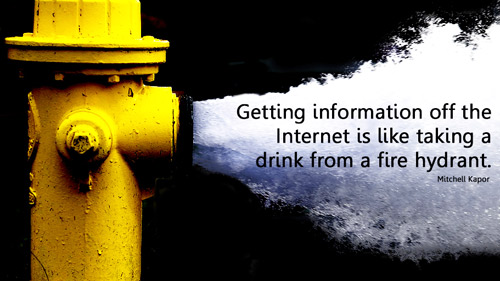
Take a look around at the current state of the web. Everything is about feeds and information overload. An entire subset of the technology industry is devoted to creating feeds of feeds (Friendfeed, Socialthing and their competitors come to mind). Information overload is currently the single largest issue facing webizens. How many articles about how to get things done and managing your email inbox have you come across online?
The Future
While I believe there are many aspects to the future of the web, from relying on cloud data storage and web-based services to the rise of mobile location-aware services and advertising, the core of the future web will be about technologies that help users cut down on information overload. That is, taking large amounts of data and providing the user with information relevant to them and people that matter to them. Technologies in this space are collaborative filtering, singular value decompositions (think Netflix’s recommendations), artificial intelligence and latent semantic analysis.
I guess you could say this goes along with the “semantic web” concept of helping machines communicate with other machines and find relationships between data. In a fully realized form, these technologies will allow machines to learn and understand the tastes and preferences of the user and help filter through open data to provide the user with information they want, need and what they didn’t know they liked. Abiding by the long tail concept (although a study recently proved otherwise), web users don’t necessarily like only the popular items, making it hard for current systems to adequately predict what the user wants or is looking for. I’m not just talking about reading feeds, but rather sifting through any open, linked data on the web, which brings me to my next point.
The future of the web will usher in open data. Businesses need to stop locking up their data. Just put it out there. Users will embrace it and it can only help with business. Publishing 2.0 put it well in an article about data:
The future of the web will be determined by companies that can overcome people challenges — to bring EVERYONE’S data online, and make it useful. And it won’t be about locking up people’s data, but instead helping them be smart about the free flow of their data.
It will be about networking that data, connecting it, to make a whole greater than the sum of the parts. That’s why web applications are so much more powerful than siloed desktop applications. That’s why the web itself is so powerful — it’s not just about collecting and distributing data. It’s about connecting data. And about connecting people.
Overall
The future of the web is about efficiency. While the semantic web concept is about machines communicating with machines, we also really need a way for machines to understand humans.
When will we know when we have arrived at the future of the web? I like to think it’s when we reach Arthur C. Clark’s third law of prediction:
Any sufficiently advanced technology is indistinguishable from magic.
Other Tech
I only took on a single point of what I believe the future of the web will be about. I also feel that Data Portability, OpenID and the Social Graph will be interesting areas to watch. Users should not have to maintain multiple versions of their data, identity and connections on different websites.
I’m also pretty excited about where mobile location-aware services are headed. Wouldn’t you love to drive by a restaurant and immediately be notified of their $2 tacos deal? Okay, that’s not a strong example but you catch my drift. Fifty percent of Nokia phones will have GPS by 2010, 100 percent of Apple phones will have GPS by July 11th, 2008, and so on. The potential is there.
What do you think the future of the web holds?


My strongest opinion on the future of the web is one you briefly mentioned: the cloud. The way that people are storing email and files online and relying on that data is much different from the last generation of computers/internet.
I am starting to wonder if the next phase of computers will see the general public “downgrade” to basically internet terminals. Like the Asus eee and the Macbook Air, perhaps we could see slimmed down laptops with smaller hard drives and specs that essentially allow access to the cloud.
I think this could change both the web and a lot of computing hardware (though professionals would still need power machines for video editing, etc.).
The information overload is key to those of us looking to make a difference - It creates the need and opportunity for passionate people to create successful “niche” markets. Paul’s blog is a great example, the rest of us shall take notes!
~Adam
I agree with Justin there, infact, I am currently working on a business proposal along the terminal lines as i type
PS: Great points. I’d love to see that idea of information sharing at the enterprise level come about, but I assume it’s long away. Also, mobile location tech should def pop in the next few years.
great post dude, i think most important component is getting users to give consistent up-to-date taste and preference data. AI has failed because it’s based on the concept of an expert system delivering an insane amount of data to a blackbox until it becomes ‘alive’. however, things change rapidly and the only way to really make it intelligent is to have a consistent flow of information every day to the system. The top microblogging services own this opp right now, but a real winner might emerge by building on the backs of the microblogging services, and focusing on the intelligent organization and recommendation of information
@Greg - you bring up a good point about microblogging services as the place for tastes, prefs, and just general user data. It would be amazing if some high level natural language processing and taste engine could read my 5,000 or so Twitter posts and just “know” who I am and what my personality is like.. it would understand that I like high-performance cars and point me to interesting videos or .. etc
I agree with your assessment of the future Internet and the way we’ll feel like we actually live in it instead of on it. I don’t so much think the information overload will take such a drastic turn to terminal style computing, but I do see a tipping point for software and most forms of data. One day, everything will have some type of Internet access, whether it is from the power outlet or through the air, or just a plain cat cable.
Most forms of software will in essence just be a web browser and instead of going to BestBuy to get the latest PhotoShop 20, you’ll just hit an upgrade button on your current PhotoShop 19 and they’ll give you access to it (nothing to install, it’s just there). You’ll either keep most of your files on a hosted file server (accessible from your phone, car, buddy’s house, work, etc) or you’ll have your own data server at home that does the same thing.
You’ll be able to sit down at your computer or pick up your phone in the morning and start your car, turn on the shower, start the coffee and toast, and see how much milk is left in the fridge all from your desk. You wont have to though, since everything will remember your routine and just do what it’s supposed to on its own.
You see, the problem (and wonder) of information overload is we are getting used to it. It is making us lazy (and OCD at the same time) and everyone that used to be called geek is just a normal guy/gal. The future of the Internet? Look around you, that’s where it will be…
People aren’t perfect either, so the good ole days will be when you didn’t have to get an email from your fridge every hour telling you the milk carton is almost empty. Your car was a place where you could turn off the cell phone and just cruise in peace. You didn’t always know exactly where your kids were and how much trouble they’d be in until that moment arrived. We’re making a better world, or so we say :P
What about privacy? Sure. The early adopters may feel fine about giving away their most intimate details (preferences, tastes, whatever…). But what about the non-tech, every day citizen? What about the “big brother cynics” or the shy?
Perhaps the most important industry in Web’s future will be individual online image consultants.
Maybe in the future a user will log on to the internet and think, “Which of my personalities will I be today? Fafhrd, the lawful good, or Gray Mouser, the chaotic neutral.”
Maybe we need an algorithm to make the web forget.
Scenario:
“So, Mr. Stamatiou, you want to run for President? Is it true that 25 years ago you posted a photo that indicated that you were driving 114 mph in a 65 mph zone? Is this the kind of reckless leadership that this country is looking for?”
Ok, ok. I’m having a little fun. My point is there are serious hurdles that must be solved (and should be solved) before user data is totally open. Will a technology based upon this openness be successful outside of the tech-savvy early adopters prior to solving the privacy issue?
Fast access to relevant information is the future (cutting through spam / irrelevant data and using user context to provide more intelligent results). How it is implemented is left to be seen. I also think global biasing will be replaced with local biasing. For example, if you search in Google for ‘rim job’ you get a page filled with porn references. This is because most people associate that term with porn and not a job at RIM (Research in Motion - creators of the Blackberry). Similar issues show up with terms like ‘cancer’ (astrology or medical) and ‘Paris’ (Hilton or country). Search is still in its infancy.
The Network Computer. Larry Ellison was right. Sort of. :)
hey, nice article. Information overload, however, doesn’t make people any smarter, if they don’t want to be.
“‘Paris’ (Hilton or country).” Paris is a city. in France. (The country.)
:) (apologies if the commenter was being clever and funny)
And I agree with Alan- privacy is important. However, privacy, at the end of the line, is up to you- in the most extreme case, you can choose to stay off the net, or use a pseudonym and reveal as many details as you choose to.
I will focus on the future of the web as a direct link to what consumers really need in terms of hard goods. For instance, a few years ago there were a handful of discount stock brokers that could charge larger fees for trades. Now, with the implementation of online advertising, sites like Zecco can offer commission free trading because of this generated revenue. The same can be said for online retailers like amazon and buy.com. Why would I drive to the store (gas is outrageous) and pay a higher price for something when I can order it and they’ll ship it to me, a large part of the time for free? The internet has already produced corporate competition beyond our wildest beliefs, and I think it will continue to drive sales.
On a side note Paul; I gave you props when I signed up for hosting at Media Temple. Hopefully you got a kick back. I’m using Skribit too. Love the posts, keep it up.
we seem to be stuck in 0’s and 1’s where 2’s (characteristic) would be more effective. similarly a cluster of 2’s would be more intuitive than a cloud of 0’s and 1’s. onward towards thought recognition and the iCap.
comment: anyone who hasn’t driven over 100 mph is not worthy of presidential consideration.
errata: it’s Photoshop not PhotoShop (no inner cap)
Paul,
Very good points. The problem on the horizon is “Information Overload”. The trouble with Web 2.0 technologies is that they remain unaware of this problem.
We don’t need prettier pages, or slicker widgets. We just need to be able to get at the “Raw Data” behind the pretty pages and widgets.
The ability to view data in a myriad of purpose specific contexts is the big issue, as you’ve allueded to in this very insightful post.
Related:
1. My Linked Data Planet Keynote
2. Data Portability & Linked Data Spaces Presentation
Yay! Now I can be spammed while I drive by every restaurant on the block! The future just keeps getting better and better.
Hey Paul, I love reading posts like this. All very good thoughts on Web 3.0.
I’ll chip in my 2 cents and throw another view into the mix. As a user interface and visual designer, I like to think not only of the future of the web in terms of the backend technology behind everything, but also the frontend UI that people will use to interact with the backend. At the moment, I personally feel like the “Internet” is a very static place that often lacks life and vibrance - it’s an environment that most usually doesn’t give users an organic feel. It’s just data data data like you said, all crammed down people’s throats in the form of text, images, and links to more text, links, and images. I think (or at least would like to think) that we’re going to start seeing all kinds of great frontend stuff from developers, especially with Flex’s rise to popularity and better Flash technologies on the horizon…we could start seeing new 3D applications (the weather globe for the Wii Weather Channel comes to mind), better and more simple visualizations of data, and incredibly intuitive interaction models. Also, I believe that the standard input for computers is eventually going to change as well. The day that every computer has a touch screen is the day that my interface design dreams for the Internet die and go to heaven.
Anyways, all that to say that I certainly hope that the way people interact with Web 3.0 is a step up from a lot of the static content we have now. =p