Twitter: OH in class, big term paper due in a few min: "I don't know what my thesis is.. I [...]

The Future of Computing: SSD

Nov 14, 2007 in , ,

Over the past decade computers have become progressively faster and faster at an astonishing rate. However, one main bottleneck always remained - the hard drive. While hard drive technology advancements such as perpendicular magnetic recording are giving 7200RPM drives performance on par with that of regular 10,000RPM drives, SSDs offer even greater improvements.
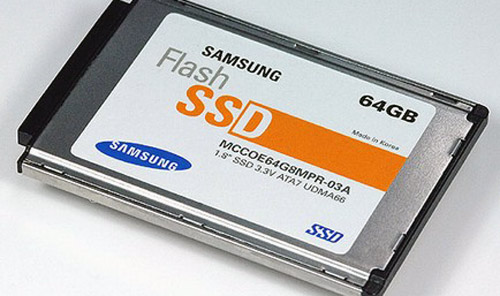
Samsung SSD

Solid State Drives have started being offered in new computers and we will be seeing an increasing trend as they come down to a reasonable price (Newegg.com lists a 128GB SSD at $3,800 at the moment). But I’ll tell you why I want one now.

SSDs are composed of non-volatile (data remains when there’s no power) NAND flash memory and are considerably faster in general when compared to their spindled counterparts. I say in general because SSDs have slower random write speeds due to technical implications of the memory. In addition to being faster than disk drives overall, SSDs benefit from less power consumption, incredible seek/access times (like 0.2 msec for random access compared to ~8ms + latency for a typical 7.2kRPM drive), no time needed for “spin up”, lower heat output and are silent and more rugged from no moving parts.

Here’s where I and other mobile users would benefit from SSDs: longer battery life and less heat production. More importantly though, your data is safe should you ever drop your laptop. Yeah, you might break the actual computer or crack the motherboard, but need not worry as your precious data is still safe. So far SSDs are sounding just about perfect with the exception of cost.

Unfortunately like all NAND memory, SSDs have limited write cycles. Higher-end NAND that might be found in current SSDs could perform well up to about 1 million writes, after which your data won’t be safe and random memory blocks may just stop responding to write requests. This may mean that the SSD will only last a year for the power user and no more than 3 for the average user. Don’t quote me on that though; it’s pure speculation based on personal experience with other flash devices and an electrical engineering course I took 3 years ago. Edit: It appears that SSD manufacturers like Adtron are offering 3 year warranties - perhaps a testament to the improvements in modern flash chips?

However, drive lifetime depends heavily on the type of SSD and usage cases, but you get the point. There’s a high early adopter risk with SSDs. Regardless, if I found a place that sold Samsung’s 64GB SSD (they seem to be only OEM at the moment), not much would be stopping me from buying it, even if it was $1k and even though I don’t have $1k.

Samsung recently announced a 1.8-inch SSD boasting sequential write speeds of 100MB/s and read speeds of 120MB/s - that is the definition of stupid fast.

What’s better than an SSD? Two. In RAID 0. In your MacBook Pro with the optical drive removed.

To SSD or not to SSD, that is the question.

Promote this article on various sites or email to your friends:     


19 Comments

  1. I’ll wait 5 years until I can get that same 128 GB drive for 50 bucks.

  2. Solid state disks seem pretty promising. But I think I’ll wait another year at least to they can get the flaws out and, of course until the price drops :)

  3. mmm. Sounds yay- but if it has limited write cycles, you’re going to have to get another one (set) eventually- but I guess that’s the same with regular spindle drives?

    Heheh. “go jogging with your laptop” ads not far in the future?

  4. I am excited to see where SSD technology goes. I can see the value behind increased performance, less power consumption etc, however, do agree with the concerns over limited life. The limited write cycles is an issue that can be improved with innovations to the technology.

    I know some organizations are using SSD technology in their datacenters. I’d be interested in more detailed comparisons relating to power consumption, and performance.

  5. These seem cool, but how many years will it be until I can buy a 250GB SSD for my Macbook for under $200?

  6. Yeah I’m with the other guys on waiting for the price drop!

  7. Lots of people seem really hung up on the capacity of these drives. Perhaps we’ve lost sight of the fact that you can easily do a full install of XP Pro & Office ‘03 on a 4GB drive and still have (a little) room to spare.

    I’d be more than happy to trade the space limitations of a 32GB SSD drive for the upside of blistering speed, far lower power consuption, and less heat.

  8. A 250 GB drive for £500, the MiniDisk player, and MacFUSE… My my mini away- was probably my fault, and in the end I replaced it with an iMac so not all bad.

  9. Sorry Paul- I wrote that on the wrong page.

  10. With the relatively cheap cost of external drives these days, storage is less of an issue on a primary drive. I think that a computer’s main HD being SSD could speed things up quite a bit, and people could use Firewire drives for editing large video files, etc.

  11. Justin said it very well — mass storage is cheap and you don’t need “stupid fast” to store media and other data (at least for now). As they get more affordable and accepted, I’ll likely use a SSD as my working drive and a traditional HDD for storage.

    Great post Paul.

  12. TechBargains says that NewEgg has a 32GB SSD for 300.

  13. I suppose with a SSD there would be a dramatic improvement in boot time for Windows O/S PCs! I would love to see a comparison test.

  14. I work for a major UK broadcaster, so obviously we use a seriously large amount of digital storage space. Currently everything is stored on state-of-the-art Omneon MediaGrid digital storage servers. However, the intention is to move towards solid-state, due to the huge amount of power and energy required to keep the servers cool.

  1. [...] that the MacBook Air is fairly secure from the hardware perspective. Even more so if you have a Solid State Drive in it. I digress, but SSDs are notoriously bad when it comes to data recovery; that is, bad for you [...]

  2. [...] a mediocre 5400RPM 320GB hard drive. After a bit of help from Titanas, I ordered Intel’s new SSD for this laptop. It’s the 80GB X25-M and runs for about $600-700 USD if you can find it. [...]

  3. [...] has almost been a year since I wrote about the future of computing and how I thought that it was all about Solid State Drives (this was before I became infatuated [...]

  4. [...] has almost been a year since I wrote about the future of computing and how I thought that it was all about Solid State Drives (this was before I became infatuated [...]

Post a comment, receive Stammy points.


Send a trackback.


  • If you plan on posting code, run it through Postable first.
Copyright © 2005 - 2008 PaulStamatiou.com  Privacy Policy - Terms of Service Can't spell my name? Use PSTAM.com. Go back up ↑.