First Impressions: Habari Blogging Platform
Take one part die-hard WordPress contributors, combine it with one part up-to-date coding environment and you get Habari. It started less than a year ago with the idea from several WordPress users who wanted more control over what features get put into their blogging platform. The main difference is what’s behind the front-end. Habari is, in a nutshell, a capable blogging platform “using all of this year’s tools”; object-oriented code with PHP5, PHP Data Objects, and database independence with MySQL, SQLite and Postgres. While WordPress has been around for years and uses older yet tried-and-true coding practices to ensure maximum compatibility among various webhosts, Habari is more about efficient code to essentially provide a better performing platform. To get a better idea regarding what Habari is all about, I highly recommend you read this lengthy post by a Habari founder.
There are different reasons for using different tools as each has its strengths. I hope that time proves out Habari’s choice to focus on community involvement in every step - planning, design, implementation, distribution, through support. Habari has also chosen to focus on modern technology and coding techniques that legacy systems are not as easily able to integrate.
Earlier this month, the second release of Habari’s Developer Review was put online. I installed it on a server and took it for a test drive.
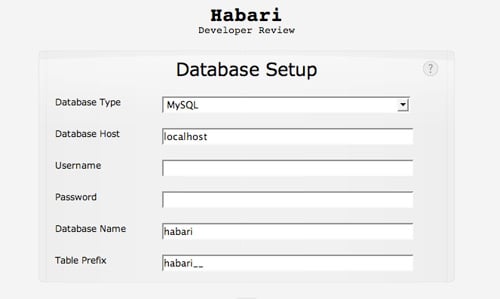
Habari installation isn’t as pretty as WordPress’s matured and famous 5 minute install, but it’s not far off. After an SVN checkout, directory chmod, creating a database and filling out the fields above, I was pretty much done.
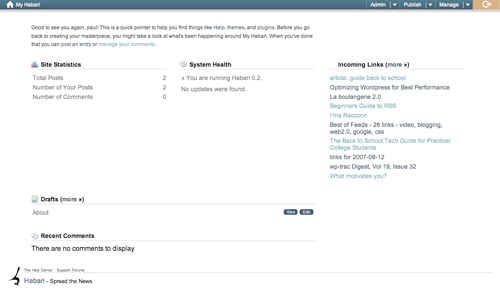
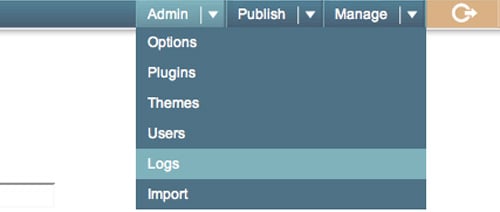
This is Habari’s simple admin panel. It might look vaguely familiar from early mockups of Shuttle, a WordPress admin panel beautification project that never came to fruition. Habari doesn’t have all the bells and whistles of WordPress by far but I find the drop-down navigation menus easier to work with. Rather than having to select a page first to see the sub-navigation as with WordPress, you can just hover over it - saving you a click.
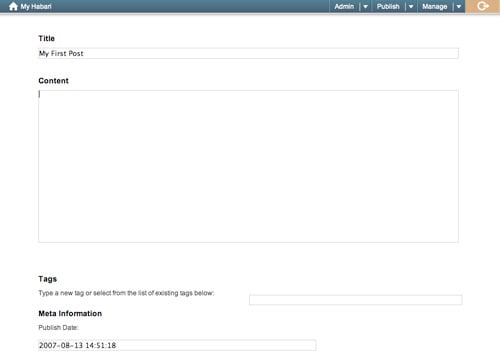
At the moment, Habari’s post page is fairly void except for a few fields.
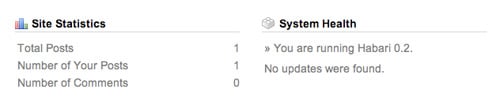
The bottom of the Habari admin panel has a small bar with basic blog stats and more importantly, a notification system to let you know if your Habari installation needs to be upgraded. This is an improvement over WordPress, where you have to know what version you are running and keep up with the news to see if there is a new WordPress version out. Although, this is in the works for WordPress.
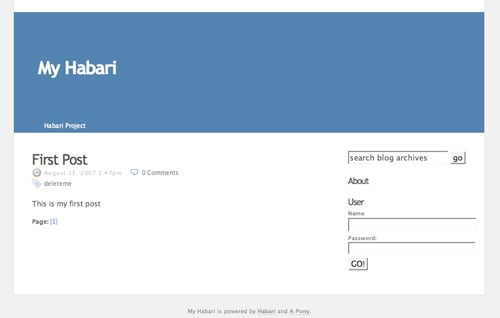
Finally, this is the default blog installation for Habari; a plain K2 theme.
Overall
Habari is bleeding edge software right now and not fit for production use. However, that doesn’t mean you should ignore it. It’s no secret that I am a website performance and optimization junkie, all the more piquing my interest in Habari’s cutting-edge back-end code. It will take a considerable amount of time for Habari to round up faithful users and establish a community capable of creating useful plugins and themes to lure in regular users. Habari’s creators didn’t set out to create a WordPress competitor, just a blogging platform for a different kind of WordPress user. I applaud everyone’s efforts for Habari and await further releases. In the meantime, I have been reading through WordPress’s trac tickets for the 2.3 release, helping out where I can.
What do you think of Habari?


How would you rate Habari as a general content management system, like Wordpress can be used for? Is it still just for blogging or can it go further?
Not sure why the utter disregard for Textpattern, Paul, I’d be interested to hear what you think about it compared to Wordpress / Habari.
I’ve only messed with Textpattern once and don’t know enough about it to even talk about it. ;-)
The navigation is a huge plus, but WordPress still takes the cake for now. I can really see this going somewhere in the future though!
Hi Paul, thanks for taking the time to give Habari a shot. We’re very enthusiastic about our project, and we think it has value to add even for people who are familiar with software like WordPress and Textpattern.
Regarding our not-quite-5-minute-install, I’ve heard of WP installs taking that short a time, but I’ve also heard of them being much more involved. One of the things we’re trying to address with our installer (perhaps complete in version 0.3) is that it gives you feedback when it notices that something is wrong, rather than just throwing inexplicable errors. Clicking the questionmark on the page in your screenshot of the installer will reveal inline help for every field, and eventually links to the bundled documentation. We’re really proud of these types of refinements to the user experience in Habari.
To address Geof’s question, Habari is designed to be good blog software. To make it “good” it has to be built on a good foundation. I think people will be pleased by what our foundation will let you do beyond blogging.
Thanks again for the trial, and I hope you’ll give our next release a whirl when it’s ready.
I too have been tracking Habari. I like that they are using the latest technologies, which I believe have a benefit. But the critical factor will be if those technologies make it better for the blogger, in terms of ease, simplicity, security and performance. It is an important work to track.
What cons and pros Habari vs. Wordpress? (I’m not talking about huge Wordpress themes and plugins collection).
I like the ideas behind Habari - but as an shared-hosting user I can’t even try it because of the need for PHP5 with PDO.
Well honestly I’ve gotten tired of tweaking PHP lines, of hacking JavaScripts, of developing Ajax websites, of setting file permissions to make your Wordpress plugins finally work, of creating databases to add a new feature to my weblog, of modifying my .htaccess file? of playing around with my CSS all day long to figure out what themes I really want to use… So it’s not like something like Habari ’s gonna make my life much simpler.
Believe it or not after 3 or 4 years of wasting my time on web dev stuff, I’ve ditched my Flickr Pro account and canceled my web host. I moved to .Mac + iWeb + web galleries… far less cheaper, far more storage and…it just works. Sometimes the simplest tools are not always targeting noobs but people who just want to actually “use” their tools and not tweak them. I would have jumped on Habari 6 months ago though.
Sadly like Daniel, I’m also on a hosting company that doesn’t support PHP5 with PDO… not yet anyway, I fired off an email to find out when they are upgrading seeing it was announced that PHP 4 will be discontinued.
Cheers for checking it out Paul.
Great review Paul. It’s always nice to see what’s out there even if it won’t run on my shared host with archaic php4/mysql3.
For folks on shared hosting without access to PHP5, I encourage you to investigate the GoPHP5 initiative. Tell your hosting providers about it, and encourage them to upgrade.
Abhijit: we feel strongly that Habari’s use of newer technologies will greatly improve our functionality. As an example, our use of object oriented development means that plugins can extend a base Plugin class, and immediately inherit a lot of core functionality, saving the plugin author from the tedium of recreating the same methods with every plugin they create. The same (hopefully) will hold true with our plans for media management: a base Media class can be extended by different media handlers (images, videos, audio, etc) and each of these media handlers can immediately benefit from not having to reinvent basic storage functions.
Pawka: to the average user, there ought not be too many differences. I mean, WordPress, Drupal, TextPattern, and Habari all essentially do the same thing: they let people publish web content using their web browser. We hope that Habari will be intuitive and easy-to-use for everyone, yet be powerful and extensible enough to create unique solutions through the use of plugins. Remember that Habari is not yet ready for prime time, so drawing comparisons between it and other tools is not a particularly useful exercise at this time.
Looks great i will give it a try in my sandbox
Thanks for the heads up on Habari. As much as people talk about the famous five minute install I don’t anyone (or more likely the average blogger) has only taken five minutes to install it. I think most bloggers use the auto install of Fanastico.
Habari is looking good as a alternative for..umm if I can say that “bored” users.
It’s quite coming from the “future” [the short one] and I think that timing is really important while releasing such a platform [for bloggers e.t.c.]
[offtopic]
By the way: Habari is also used in Greek Language and I didn’t knew it comes from Swahili [see Google code]. I think the roots of this word are Turkish [haber] but anyway.. :p [It has the same meaning everywhere]
[/offtopic]
I have had a few chats with Chris J. Davis, about Habari, and I think that in a few month’s time it will be matured enough to run on a production blog. Right now Habari is missing lots of features and is not 100% safe, but once version 1 comes out, I for one will not be using Wordpress.
I am quite impressed, actually. It’s just simple, and it works.
http://www.flickr.com/photos/hauntedpalace/1153135875/
Well as a complete wordpress junkie and a complete code clean freak, this def tears me in two. One half of me loves the familiar wordpress. And now that I know it, I can wield the wordpress engine to make, pretty much any type of site I want. On the other hand, I know its full of not-so-fast code and def gets a little goofy at time. For now I think i’ll stick with WP 2.3 BUT i will def keep my eye on this.
In reality i’m looking for a framework that will be a little nicer to live with with categories, sub categories, tags, image uploads…etc. But without the junk of say expression engine. And a little more done for me than say, cake. Anyone have any suggestions