Thoughts on WiMAX
While it may sound like some paltry attempt to evangelize another form of Wi-Fi connectivity, WiMax is a substantially different technology that’s aiming high. Why is this something to familiarize yourself with? Last week WiMAX was “turned on” for the city of Baltimore, Maryland - and many more cities are on the way. In a nutshell, WiMAX refers to a set of technical specifications detailing a network based on the IEEE 802.16 protocol.
Not to be confused with 802.11 (what you currently know as Wi-Fi), 802.16 is a standard for point to multipoint broadband wireless connectivity. The current revision, 802.16e-2005, has provisions for mobile broadband access, dubbed Mobile WiMAX, such as while in a car at highway speeds. Aside from those details, Mobile WiMAX is a type of 4G network, although this is currently classified as Pre-4G since there is no formal definition of 4G. On an unrelated note, I am looking forward to 4G’s inherent IPv6 support. This could usher in another strong push for IPv6 support across all Internet-connected devices and hopefully quench the forthcoming IPv4 address exhaustion.
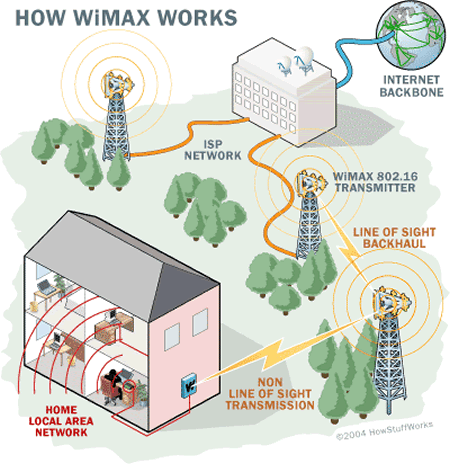
A basic diagram showing how Fixed WiMAX works.. but the real benefits come with Mobile WiMAX as well as femtocells.
WiMAX suffers from the archaic issue that most wireless technologies subscribe by - the further away you are from the origin, the more bit errors you’ll encounter and thus the slower your access will be to maintain acceptable service. Fortunately, the quality-of-service implementation in WiMAX will ensure more efficient data transmission. Also, you’re competing for the same connection with other users in your geographical area. Adding more WiMAX towers to the network will allay these issues but that will take time.
In practical terms current WiMAX rollouts, such as Sprint’s XOHM service, brings users download speeds of 2-4 Mbps. My first reaction - so what? That’s not terribly fast. Hopefully these speeds will ramp up slowly in the next 5 years. The theoretical limitation of WiMAX is around 70 Mbps albeit at very short ranges, so it is more feasible that the end user will see something around 10Mbps with a mature implementation. The release of WiMAX based on 802.16m will boost that number up to 1 Gbps for fixed usage and 100 Mbps for mobile applications, probably not coming to you in 2010-11. Also, WiMAX’s line-of-sight limitation is 30 miles and a weak 1-5 miles for not line-of-sight environments. For sufficient coverage of an entire city, it will take a ton of WiMAX towers and subsequently even more backhaul towers to relay the signals from the line-of-sight towers transmitters to the end-user. That doesn’t sound easy.
Aside from the technology behind WiMAX, how will this be different than 3G connectivity that many of us use with our laptops? Jason Hiner at ZDNet suggests that the affordable embeddable broadband aspect of WiMAX will be something to keep an eye on.
Embedded WiMAX chips for laptops, for example, are already cheaper than their embedded 3G counterparts. For example, a WiMAX module will typically add about $60-$80 to the price of a laptop, while embedded 3G will add $150-$200.
But beyond that, these cheap WiMAX chips are poised to be embedded in all kinds of devices, including
- Parking meters
- Home energy meters
- Vending machines
- Toys
- Traffic lights
- Cars and other motor vehicles
I think this will be huge, assuming other WiMAX providers structure their pricing plans after Sprint’s XOHM, which boasts contract-free options like a $10 day pass and $35 for on-the-go monthly access. Compare this to AT&T’s 3G LaptopConnect cards which require a $60 per month data plan that only accomodates a mere 5GB of included data transfer.
WiMAX: Zero or Hero?
WiMAX has been exorbitantly hyped since the 2001 inception of the WiMAX Forum. It’s 2008 and most people think WiMAX is like municipal Wi-Fi on steriods. Beyond consumer confusion, basic WiMAX coverage is at least 2-3 years away for those living in major U.S. cities. Only Sprint and Clearwire are currently backing WiMAX expansion while others are working towards the next hot thing: Long Term Evolution, which from what I can tell, is superior to WiMAX is every way (peak download rates of 326 Mbps) other than not being here yet.
You will keep hearing about WiMAX, especially with Intel’s Centrino 2 chipset supporting WiMAX as part of its core functionality. However, I think WiMAX will struggle to make a big dent in technology and will go the way of the dodo RAMbus RDRAM.
I’ll leave you with this quote from a Venture Beat article summarizing the CTIA 2008 wireless conference:
One CEO of a WiMax operator in Australia said the technology “failed miserably” with latencies (delays) as high as 1000 ms only 400m away from a cell site, and “non-existent” non-line-of-sight reception beyond a mile away. They had to switch back to TD-CDMA just to ensure their customers got a dial tone.
What do you think about mobile broadband initiatives like WiMAX? Do you have a need for mobile broadband or are you fine with your Wi-Fi AP at home, at the university/work and at the occasional coffee shop?


Stammy Points…i don’t know what this is, but have a certain urge to amass a fortune in them! I mean…they must be worth more than the dollar right now….
I have a buddy that lives out of range for DSL or cable, and opted for the area wide wi-fi instead of satellite. It is horribly slow. Hopefully competition will spark this market to be more quality and grow. I would love to see cheap quality nation wide wi-fi available in the foreseeable future.
I have the AT&T laptop card program (sierra wireless 810u or whatever) and for 60, I get “unlimited” data. The international plan (which only includes Mexico and maybe Canada) give you the limited measurement.
Just saying.
My parents rely on that system because of their mobility and because the dish service they were getting in the rural area where they have a house SUCKED.
Since you are giving your thoughts on Wi-MAX…any thoughts on how you think it will match up against LTE whenever that gets launched? AT&T’s HSPA network has a *lot* more room to grow verses EV-DO so it may be awhile.
Sorry I pressed send without going back to clarify (new to posting, hoping for a break on that one haha)…I know you think it would be superior…was interested in more detail why other than peak speeds…sorry, my bad :-)
Hey Stammy, Great Article! You should take a look at LTE. I think WIMAX is great technology for developing countries. For existing countries the cost of implementation in terms of infrastructure is high. This is mainly because the technology is no an evolution of existing mobile wireless standards. You can already see deployment in south american and many asian countries. I am not sure if its going to succeed in the US. Verizon and AT&T have already promised LTE as their choice for 4/4.5 G networks.
Cheers,
Akshay
Last year here in Italy we had the public auction for the WiMax frequencies, and in these days some providers are switching on their networks here in the north of the country.
The problem here is that since some years we have a lot of local providers offering wireless connectivity through Hiperlan, which doesn’t need a license like WiMax does. Hiperlan providers offers speed in the range 640kbps - 50 Mbps, and this can be very harmful (from a commercial point of view) for the WiMax success.
Anyway, I keep thinking that WiMax can be good to reduce the digital divide in some areas, but not to provide primary internet connectivity to the entire world…
We in India have no right to dream about this! There are couple of places here were dialup connection is not available too. However, lucky! We have been catered with broad band connection.
I can’t wait to have this service, Malaysia has it and it’s still and ongoing trial. So it’s free. I typed this comment while in the car my friend was the driver.
I agree with @Akshay. WiMax won’t succeed in the US unless it starts using unlicensed spectrum; in that case if would be a Wi-Fi replacement technology. Intel will always support it because they have so much invested in the standard.
Being in the telco industry for quite some time, I can assure you that wimax is not that doomed (at least not yet). As for Today, Wimax is being deployed in many countries (from Eastern Europe, To Pakistan, through KSA or South East Asia).
That being said, today Wimax is not positioning itself as a direct competitor of the LTE but rather as an alternative way for an operator to have its network evolved towards the next big step (dubbed 4G).
To dumb things and strategies down, incumbent fix operators and ISP will rather go Wimax (for the Wirless DSL feel of the techno) while mobile operators will rather go towards LTE (which evolves fairly easily from today 2G/3G/CDMA networks) before all evolving towards 4G one day.
But then you have to add the regulatory perspective and lobbying… So all in all, the picture is insanly complex. Having said that, your wrap up is touching base correctly!
PS: the main challenge for all this, as your post is letting guess, is the backhauling, that my friend will be the mother of all the challenges… but other topic other day :-)
Take care, and keep it going.
I’m using a Huawei E870 3G card when on-the-go with my MacBook Pro — it’s fantastic. The DSL connection at home is actually slower than surfing via 3G (HSDPA/HSUPA) with a strong signal :D
Disclaimer - I understand that it depends on specific implementation and coverage. Still I am far from inspired.
We use wimax at work (linking buildings to central office) and it’s simply terrible. At first it was so bad that users actually kept asking to go back on dialup.
It’s tricky to get line of sight in the city with base stations covering big areas. And without line of sight it’s total crap. But hype prevailed and instead of investing in reliable optical links we are stuck with crappy expensive wireless.
Time will show is it any good but my advice - don’t be fast to jump on everything hyped.
I used WiMax in Pakistan through Wateen. It was the most horrid experience ever. Speeds were nil and the connection choppy at best. They asked me to install a fixed access point, but I refused because DSL was cheaper/better/faster.
WiMAX is kind of interesting, but I don’t think it’ll be very successful. For the time being, my campus has nearly ubiquitous wireless coverage.
Despite whatever advances in wireless technology, I think I will always prefer a wired connection. I like the stable connection that I can be sure won’t be dropped.
@ Sooraj
I think India has plans to provide the more rural areas with wireless internet. Whether it is WiMAX or not I don’t know. But wireless is the most sensible way to go as it is cheaper and the people catered for is much greater in this country with so much demand.
I have seen pictures of mobile carts sporting a full desktop computer with printer and the works. I do not know if they have internet access but it seems the logical thing to have.
Early testing by our work is showing it’s a very promising technology for something slightly different to broadband usage.
That said, we were getting >17Mbps in early testing before optimisation. I’ll see if I can release any more info to you mate ;)