Google to Further Personalize Results?
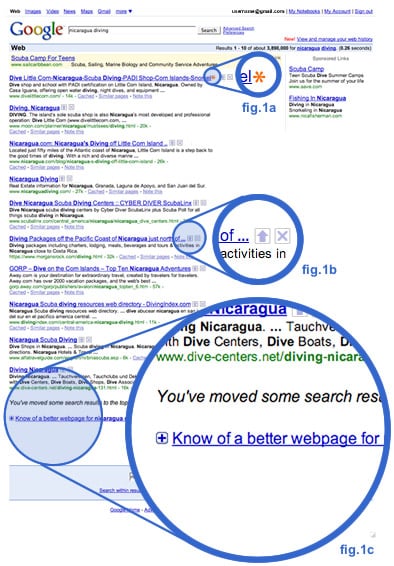
Based on this Google Experimental Search page, it seems as though Google is testing out a prospective feature for search results - voting. The SERPs show an “up” icon and an “X” icon. If a search result is completely irrelevant for what you were searching for, clicking the “X” icon will remove the result from further similar searches while clicking the up icon will raise that result’s ranking.

Furthermore, users would be able to suggest relevant webpages to include in the results. Before you start pondering what a gamed Google SERP page might look like, with horribly inaccurate and spammy results - these experimental features are per-user only. Each user must be logged in and any changes made are for that user only and may be reverted easily.
Is it permanent?
Your changes will be applied each time you search for the same keyword(s). There’s a link at the bottom of the search results that lets you view the results in their original ordering.
But how useful could this be should it ever become a feature, if the feature remains per-user only? It only seems like it would be useful if you search for the same keywords quite often. My searches are highly random with my last few searches being “iphone tinyproxy + tether”, “corvette zr1″, “cool bottle openers” (yes, I found one), “svn bus error” and a phone number of a missed call. As such, I don’t think this feature would prove useful for me.
Would you use this feature should it ever come along?


I would most-likely use it seeing as I often forget to bookmark things or am too lazy to type the whole address so I just google it. For example I have been trying (so far unsuccessfully) to learn PHP. So every time I feel like learning more I just google for PHP tutorials and pick the one I had last.
What I would hope to see with this personalization, is Google then using that en mass to actually effect placement. So often, as I am doing searches, obvious spam sites pop up on the front page. It would be nice to be able to “bury” them. While I understand the implications from a competitive nature, if say 100,000 people bury the same site in one day, that should effect placement, whereas if 100 do, it shouldn’t.
It will be interesting to see if Google does use these personalized preferences to effect their universal results.
Keith: The problem is that, if they do, spam companies could then pay to have their sites voted higher in the list. That could be a very dangerous path to tread, though the only real functional one to get any use out of the service.
Per-user is too narrow to be useful, but anything other than that can muck up the results. I vote “no go” on this one, Google.
The only way it would be useful is if everyone’s voting counted, but as mentioned then it would get spammed to uselessness. This feature does not seem like it would help me.
I’m with Micah….seems like a true sites ranking could easily be tampered with way to easily. I say no deal.
I don’t think it would be useful for me, but I think some would find it indispensable. For example, Google Analytics tells me there’s someone who’s hit my web site 65 times (!) with the google search “ruby unit test command line options spatten”.
I bet that that person would love to be able to personalize their search results.
I’m just as skeptical as everyone else. If Google can figure out a way to understand the users actions on a per-user basis (i.e. someone always buries the wikipedia search results, so those will no longer show up for them), then it could prove useful. Otherwise, what’s the use?
This feature, if implemented globally, may have been useful. But then, spammers would go out of the way to game it, and it would hurt Google’s SERPs. Then, its a no-brainer that Google is still figuring how to implement this without being gamed. I just hope this spells the end of spam and wiki results for Google searches.
That’s basically how StumbleUpon works. I attended a conference here in Palo Alto where on of StumbleUpon’s co-founders described in detail how SU works. Google is basically adding the ability to better “rate” a link, not only in terms of PageRank, but also in terms of how much people like a certain link. Good move.
i know this is irrelevant, but that bottle opener..
is that the one they use on diggnation?
I guess if Google could inspire the ‘do good’ feeling of correcting inaccurate articles on Wikipedia, then they could be onto something. But as others say above, in reality I suspect it would result business springing up offering to ‘bury your competitors’.
Google would be better off having a proper, (ie. easier to find), option for reporting spam, dead, or other turds in the online flotsam.