Twitter: reading for class

Satisfaction: Slick People-Powered Customer Service

Aug 15, 2007 in ,

We all know that customer service is a pain to deal with in most cases; waiting on hold to speak to someone in a noisy call center, not getting your problem solved and just going in circles. Some companies are better at this than others with online forums and then there are small companies that haven’t even setup any form of customer service yet. Regardless of the situation, Satisfaction aims to heal your customer service woes.

Satisfaction: Slick People-Powered Customer Service

Crafted by an experienced team, including people from Adaptive Path (the company that made Measure Map, a web app for tracking site traffic, which was bought by Google and was integrated into what is now Google Analytics) and Rubyred Labs, Satisfaction is the Cambrian House of customer service in a sense. Similar to a forum, there are several sections or in this case companies up for discussion. If the company you need help with isn’t listed, you can add it yourself.

Let’s say you have a general question regarding an Apple product, such as looking for a compatible scanner…

Satisfaction: Slick People-Powered Customer Service

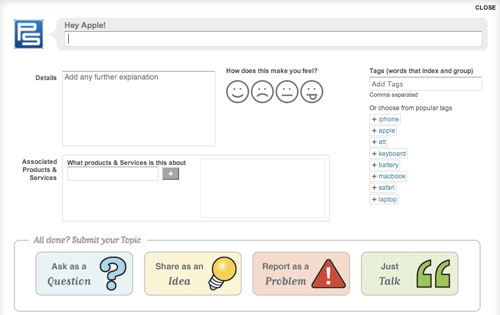
You can just hop into the Apple section, search for any related topics and if there aren’t any, submit your own. Satisfaction lets you submit your topic, add relevant tags and products/services, as well as flag it as a question, idea, problem or just plain talk. Once your topic is published, others can easily reply and hopefully your question will be answered shortly. Satisfaction also takes employees into account, so you will be able to see if anyone that replied to your topic works for the company you have an issue with.

Satisfaction: Slick People-Powered Customer Service

Replies may be “marked as useful” by users and the best ones float to the top, similar to up-voting good comments on Hacker News (née YCombinator Startup News).

In its most basic form, Satisfaction isn’t much more than a forum aimed at people needing a venue to discuss problems, ideas, issues and form a community around customer service for various companies. However, Satisfaction’s cheerful look and feel gives me the impression that it will facilitate this better than any forum would be able to.

There are a few reasons one might use Satisfaction as compared to a company’s own forums, if they have any. First off, it’s a third-party site, voiding the possibility of substantial bias in replies as you are interacting with the general e-populace. For example, Apple has been known to lock or even delete threads for issues it initially didn’t want to face, such as those random shutdown problems on MacBooks. Second, Satisfaction is a one-stop-shop for all your customer service needs. Tell people about your MacBook’s flickering screen one day, get a response from Tim O’Reilly to your question about how O’Reilly Media draws those cute animals on the covers of their books the next. Versatility like no other.

Satisfaction is still in beta and funded by angel money with future plans to monetize with possible topic-relevant advertising and “selling services to companies to help them monitor trends and communicate with customer” as Venture Beat noted.

Do you think Satisfaction will be a success? If not, what else does it need to succeed? As for my own feedback, I think Satisfaction could use a better way to find companies. There are so many companies that scrolling and pagination gets a little annoying. Perhaps a basic company search bar is in order.

Promote this article on various sites or email to your friends:     


11 Comments

  1. Looks like a interesting website. one of the main problems in Customer service is Localisation. For example I been recently trying to Figure out which laptop to buy. There are cost difference in the prices in the US and India. Plus the configs are different for the same model in the US and India. Trying to search the Dell forum for has been difficult. In the end I looked up a number of blog and asked a few of them personally to get more details and advice.

  2. FYI Google Analytics started off life as Urchin, rather than Measure Map.

  3. Seems pretty much like another 3rd party forum to me. Even though they claim to be a Customer Service site, do they really have a technology that differentiates them from any other forum? As for finding information about products, I find that searching through blogs works great to get good personal experiences with products and software.

  4. I think it’s a great idea, a centralised resource for all our questions! I don’t use forums that often, as I find looking for the right forum (one which has enough traffic and covers the topic I am interested in) hard work some times.

    The concept of forming a community solely for customer support, in one central place and provide a mechanism to help each other out is quite a strong one in my eyes and I hope Satisfaction goes from strength to strength.

    I like the feel of things at the moment, but as you say Paul, Satisfaction could definitely do with some form of search mechanism and perhaps categorization of companies.

    Cheers for the heads up on this, it’s duly bookmarked!

  5. @Damien - I know that Urchin was the core for Analytics, but I was also under the impression that Measure Map’s fancy graphs and other UI-rific features were adopted into Analytics. Or maybe Google just bought Measure Map so they wouldn’t have competition?

  6. Thanks for the kind words, Paul et al! We have big plans to add more customer service specific functionality into the site. At present, the biggest nod towards that is specifying employees and “official responses” from them in the system, but in the future we’ll be doing more type-specific features (ie, tagging a problem with “I have this problem too!” and replies with “This helped!” or “This solved my problem!” then using that to help guide people to the right answers/solutions.) We just wanted to make sure we nailed the discussion experience first, so that we could then start building service-specific functions on top of it.

    Down the line, we’re also planning to release interesting analytics around number of people participating/solving problems, biggest problems and questions, best ideas, and all sorts of other cool stuff that you’d never get from a generic forum site, as well as an API and widgets that will make it much easier for companies and organizations to integrate question asking and answering directly into their own sites.

    We also totally plan to fix the companies thing asap, I promise.

    (Also, you’re right, Paul — the Measure Map team is responsible for the new front end to Google Analytics.)

  7. Thanks for clearing that up, I was unaware of GA’s cojoined heritage.

  8. I wish them well! In my experience is easy enough to use the right words but pretty tough to deliver. Let’s face it though, they don’t have to be that great to be better than the rest!!!

  9. I agree with some of the others. A great idea, but not much to set them apart from the plethora of other help forum sites. My own preference when searching for forum-based responses to problems is just that, a search. When looking for a solution to a Microsoft problem, the last thing I do is go to Microsoft. I do a Google search with the error message and look for forum postings.

    I think their real measure of success will come from their postings and information getting ranked and showing up in organic search results. The clearest answers sometimes come from real people as opposed to ’solutions’ in an online knowledgebase.

  10. kevin, we totally agree. one of the many issues with forums we were looking to fix was their lack of connection to the rest of the web. forums tend to be walled gardens that can be wildly intimidating to outsiders who don’t have time to learn the culture or context of the group inside them. and, they’re completely useless when it comes to search — not optimized for search engines at all, and difficult to find the answer you’re looking for even when you do end up on one of those pages. in forums, the conversation tends to be long and undirected — great when you’re in conversational mode, but terrible when you just need to find an answer.

    in designing satisfaction’s discussions, we modeled each individual topic page not on the forum model, but instead on a blog comment model, not unlike the page i’m typing into right now. much more self-contained, much more accessible to someone who shows up to see that page and that page only. then we layered on some interesting summary applications, like the ability to float the most useful answers to the top of the page — all with the explicit goal of making the path from google->topic page->answer as quick and as clean as possible.

    we feel like we’ve nailed the discussion setup pretty well — and our next round of improvements is all about building customer service specific functionality on top of the generalized discussion model you see now. so expect in the near future. many more customer and company-oriented tools that will continue to widen the gulf between what we’re doing and an out of the box forum tool.

  1. Customer Service:Web 2.0 Style…

    It’s fascinating how the internet is slowly becoming a catalyst that causes a paradigm shift in even the most stubborn, most stodgy company’s way of doing business. This is most noticeable in the banking industry–Typically, banks rel…

Post a comment, receive Stammy points.


Send a trackback.


  • If you plan on posting code, run it through Postable first.
Copyright © 2005 - 2008 PaulStamatiou.com  Privacy Policy - Terms of Service Can't spell my name? Use PSTAM.com. Go back up ↑.