Twitter: thinking of retiring my 5 year old hp laserjet 1012 and springing for something wireless [...]

Review: iDefrag for OS X

Jan 05, 2006 in , ,

iDefrag

Today I explore the whole “You don’t need to defrag” situation regarding Macs. Technically, OS X is supposed to take care of everything with a journaled filesystem and system maintenance when the computer is idle, but my system has become awfully slow recently. I decided to check out iDefrag from Coriolis Systems after having heard about it last night on the Typical Mac User podcast (where Amber Mac happened to mention my 10 Things Every New Mac Owner Should Know article).

I had spent some time and read about other competitors for Mac defrag applications but iDefrag made the most sense. The demo version of iDefrag is crippleware, only letting you defrag 100MB or less drives. I took a chance and purchased the full iDefrag for $30, a little steep for an app that just does one thing. However, I made a good choice. iDefrag offers so many options when it comes to defragging, kind of like what Diskeeper offers for Windows.

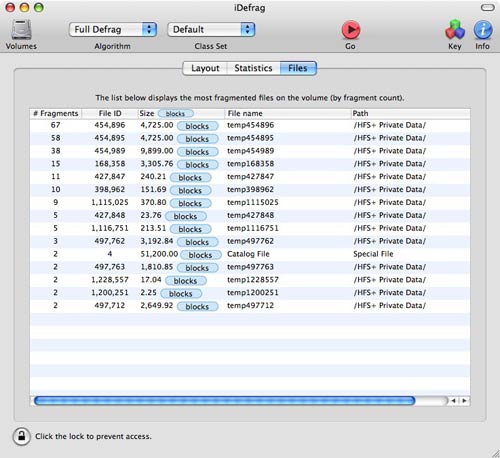
iDefrag comes bundled with an application called CDMaker that can create a boot cd used to fully defrag your main OS drive. The way that it works, your drive must be unmounted to perform more complex defrags although a simpler, on-line defrag option exists. If you like stats, iDefrag is for you. When defragging your hard drive you are given three main ways to monitor things. The first, called Layout, shows a visual interpretation of the fragmentation on your hard drive while Statistics and Files just tell it like it is. Another interesting feature in Layout mode is that you can click on a section of blocks and select View » Show Info Panel to find out what file or system resource you are looking at.

I absolutely overestimated how much OS X attempts your drive healthy; mine was completely fragmented. iDefrag features an intuitive interface, plenty of options and a disk compaction mode, great for squeezing the last bit of space on that hard drive. I highly recommend iDefrag for power users who may find the extra functionality indispensable as well as people that use their system for mission critical tasks or things like hard drive hungry video editing.

iDefrag
iDefrag
iDefrag
iDefrag

Promote this article on various sites or email to your friends:     


60 Comments

  1. I’m wondering though, how much of that would have been done by the system “eventually”. Might want to direct this post towards an expert that can tells us the ins and outs.

    Good review.

  2. It doesn’t get done by the system from my experience. I used to defrag my Powerbook every month with Drive10 and it felt like having a new machine every time it was done. I really need to do it with the dual G5 that replaced my powerbook real soon because the machine really gets slower and slower. The ‘whoah, this thing is faaaaaast!’ feeling I got when I first got it is already gone, can you imagine?

    I know for sure this is because of disk fragmentation.

    Thanks for the review Paul, I guess I need to shell out those $30 as well and get it!

  3. But Paul, did you notice a difference after you used this product?

    Do you think this product is safe to use?

  4. It seems I left out the part where I said how much faster my computer was after defragmenting. It was dramatic, my computer used to take a minute or two to boot. Now that has been cut down to about 30 seconds or less. It’s the killer system-performance app. Defragging takes a very long time (especially on the full defrag setting) so you have to schedule your time accordingly and give it 5 hours or so. I think this product is safe and would recommend it to anyone… but if you have absolutely mission critical stuff you need to be careful because if you are defragging and the power goes out you can loose some stuff. Defragging works on a part of the hard drive at a time so it will load that stuff into memory, delete that part of the disk and put it back in one place in one piece. If you were to loose power at one of those moments it would be lost from your drive and memory. You might consider a UPS in that case.

  5. Nice review Paul! The subject of whether or not Mac OS X’s Extended HFS (Journaled) file structure needs defragging has been a long standing debate. I guess this is good for anyone want to squeeze every ounce of performance out of the Macs.

  6. Paul, I’m glad you checked it out, I’d love to have your review in Audio form as a follow up to what George said on the show. As I said during the show both George and I (remember I’m a newbie so I claim to know very little here) also noticed considerable performance increase.

    It’s important to note that since I’m always working with sound file due to the podcast I move vast amounts of large files 1Gig or more around my HD like it was candy. So lots of opportunities for fragmentation to occur.

    You are correct full defrag of your internal HD takes a very long time. However I fell that as you said if you are doing lots of work with video or audio file. This application is worth even that steep price (which I agree it is). Thanks for being a listener but more importantly taking action after listening.

    Victor Cajiao
    Host of the Typical Mac User Podcast http://www.typicalmacuser.com

  7. I agree with Victor. I used it after cleaning up from all the editing we did on A Geek Christmas Carol (http://www.friendsintech.com/agcc). That took up TONS of room on my external drive as it was a large multitrack soundtrack pro project. And that was just the Ghosts of Christmas Future part. I archived the files off then did a boot and defrag. Now my external drive is back up to snuff and my editing on other things goes a lot smoother.

    George Starcher
    In the Trenches Podcast http://www.kevindevin.com

  8. I’m thinking I may have to try this program out. I work lots of images, some quite large ones which slows my iBook down a bit sometimes. £17 seems quite alot to spend on shareware though. I think I will keep an eye on the comments of this post.

  9. I purchased the app based on what I read here, and have run it on my backup drive with good success. However my boot drive is reporting only 1% fragmentation, which seems awfully small (which is good but ultimately disappointing seeing as my machine seems to bang the disk hard no matter what I am doing, and with plenty of RAM available). Hopefully the defrag of the boot drive will reap some benefits nevertheless.

  10. Make sure you downloaded the bundled CD creator app and make a boot disc to completely defrag your main drive. It helps a bunch.

  11. Good review within good timing, sir. I was thinking why we do not have to defrag even feeling my Mac slowing down. After experienced trouble that several of files in Preferences gone, made restore the files but I really felt I need check my disk up.
    I think this application works dependent on a person who uses large files more than 10 or 20MB or not. So, good idea to try this at the people who handling the graphic, music or movies. People who do nothing like that are maybe not neccesary to worrying about it.
    Anyway, after iDefrag runs, my Power Mac with 2GB RAM on it are fast like bland new. The photo data by EOS 1DsMk2 after adjusted Photoshop (and saved as PSD) are about 95MB. People who handling the photo data might has slow down problem, I guess. So, you made very good review.

  12. I purchased the app after reading Paul’s review for the fourth time and it does significanly improe performace but I cannot get my iBook to book from the boot CD that I made with their bundled app. Has anyone else had any difficulties?

  13. Hmm, nevermind apperently running the beta doesn’t do this yet. :)

  14. Had the same prob as Brett, cant get the app to boot from cd, any ideas???

  15. Works for me, are you holding “C” upon boot?

  16. What if you have your Mac set to sleep after 10 minutes of not being used? If you are defragging your hard drive will that keep your Mac from going to sleep?

  17. Same problem as James and Brett. I’m using imac duo core. Made the cd from their software. Hold the C key while rebooting and …nada!

  18. I just ran into the same problem with my Intel MM. I contacted them and they are working on a UB as this one isn’t Intel compatible just yet.

  19. I have my Mac set to sleep after 10 minutes and do not want my Mac to sleep while defragging. When defragging, does that prevent your Mac from sleeping?

  20. I wouldn’t think so. As in, it would continue defragging and not go to sleep.

  21. Hi,

    Thanks for the excellent review, my G5 was getting quite slow with loads of image files so last night I downloaded idefrag.
    I wrote the bootable cd, which worked fine and did a full defrag of my hard drive.
    Fantastic results, its like having a new computer.
    Thanks,
    Iain S Byrne

  22. Hello all. I have purchased and used this iDefrag on my two Macintoshes (PMG4 Sawtooth, and iBook G4) and it runs great.

    I don’t think the $29 or so that the program cost was unreasonable for what it does. I like specialized software like this.

    As always, make sure you have critical documents and software backed up before running any defrag software (this goes for PC or Mac). I will usually run DiskWarrior first, then Apple’s DiskUtility, and finally iDefrag.

    Works like a charm for me!

    I intend on buying the Intel Core Duo iMac 17″ today, and I hope that iDefrag is a Universal Binary - I look forward to defragging my new iMac with it!

    Regards,
    Mark

  23. Hey, I purchased the idefrag software after reading this article and I have to be honest, I don’t see much improvement on my Mac Mini.

  24. Hello all.
    I have purchased idefrag, after reading the review and various comments. There is one thing however that I would like to ask to you. Does someone run iDegrag from a boot cd? I am asking this, since the company seems to say that it is not the best or even a suitable alternative. However, I have not partitioned my hard drive so it is the only way for me to use this software. I own a PowerMac G4 (Mirror drive) with 1,5 Go ram. Does it sound risky to run iDegraf with a CD bootable?

  25. Yes…the only way to get a complete defrag is to run it from a boot cd. idefrag comes with a program that allows you to do so. A better way to run idefrag is from an external hard drive. That would be better then from a boot cd.

  26. Also…here is a good…recent article on defragging your Mac harddrive http://www.macattorney.com/ts.html#Anchor-31774 after you read that…scroll all the way up to the top of the page and read all the things you can do for your Mac maintenance and then save that link and article for future reference.

  27. Many thanks Charlie for a so fast answer. I was reluctant to use a boot cd, since I feared that the program may lack memory. Actually, however, I don’t own an external hard drive, so I will make a backup and give it a try.
    I take a look at your article. It seems really instructive. Thanks again.

  28. Hi Folks,

    Just was wondering if anybody can help me to locate the CDMaker - which presuumably comes bundled with the software.

    Appreciate if someone helps me to understand how could I boot my machine with the cd.

    Cheers ..

  29. Hi Prasenjit,
    Once you have bought the software, you can go to the website of Coriolis System. There you will click on “customer” and log in with your passoword and email address (the same that you used when you made your purchase). You will then be able to choose “downloads” and to download the cd maker software.

    Once you have downloaded and installed “Coriolis CDMaker” in your applications, click on it. You will be able to access to some basic information if you go to help in the menu.

  30. In the review of “iDefrag” I see a discussion of its “Compaction.” I hope that it is only a referral to “Defragmentation,” and not also to “Compression.” I had a real disaster that was complicated by “Compression,” and I want nothing more to do with that.

    Let me explain the disaster. For three years I placed my trust in “Retrospect” backup software manufactured by Dantz. It was a disastrous mistake. I faithfully kept regular backups, and had made the latest backup set onto DVDs only about an hour before my hard drive totally crashed.

    To my horror, I discovered that all three years of “Retrospect” backup sets proved to be totally useless to me. Even the authorized repair shop spent a week attempting to rescue my data, and they too failed. Here were the three reasons for the useless backup sets:

    1. Retrospect keeps the index to each backup set on the very hard drive that is being backed up. If the hard drive crashes, your backup sets crash with it. (Absolutely brilliant thinking!)

    2. Dantz claims that the Retrospect software can create a new index if the existing index is lost. Well, multiple 28 hr. long attempts by myself and by the repair shop ended in failure. Not one of the backup sets could be re-indexed. Dantz refused any help.

    3. And here’s the item that broke the camel’s back and caused me to ask the above question: Retrospect uses its own proprietary method of compressing the files. No other software can decompress Retrospect’s files. That means that the backup sets were totally inaccessible without a working Retrospect index.

    Hopefully you now understand why I want nothing to do with compressed files whenever I can avoid them. I realize that I can’t totally avoid compression in an internet world, but I’m surely not going looking for compression on my own hard drive.

  31. Has anyone done a review on the performance of iDefrag vs Techtool Pro 4.5.X. I need to purchase an optimisation tool for my G5 Dual 2.5 and am unsure as to which one to go for.

    Price is definitely a factor here, but I need second opinions. My mac is chugging at the moment.

    Does anyone know of any similar utilities over and above these?

    Help!

  32. I do not know of a review on the performance of iDefrag vs Techtool Pro 4.5.X. but I have read reviews of both and iDefrag comes up the winner between the 2. This comes from several different reviews.

  33. OK…I went out and bought it. Cheap in comparison to TechTools.
    It did EXACTLY what I needed it to do. A couple of gliches, but AWESOME. See my long-winded note to the developer I was talking to re my issues:

    Thanks for your quick response Alistair

    Great stuff. All done. Installed and optimised. AWESOME SOFTWARE!!!

    Just thought I should let you know how it solved my problem…

    My G5 was having a range of startup and shutdown issues on Tiger. Apps would run and then crash without warning. Nortons used to solve all these sorts of issues for me in the past

    It would get to a certain point in the optimising process, flash a message and then shut the machine down. The message appeared so fast I had no way of reading it. I then took my digital camera and took a photo of the message as it appeared. This enabled me to go to follow the path to the objectionable file and remove it. iDefrag then ran like a dream. By shutdown and startup issues are gone and there is a DISTINCT increase in boot speed and apps loading performance.

    I ran iDefrag on my laptop as a maintenance measure and the same awesome performance imrovements apply.

    From a marketing perspective, I was just about to order TechTools Pro, when I discovered your software. IRT price/performance, you have a definite winner here, but I think you need to somehow make the Apple Resellers aware of it, esp. here in South Africa. Since Norton Utilities are no longer available, TechTool would be the next move, but with a price in excess of R1200.00 (GBP170.00) it becomes prohibitive, as well as not that readily available.

    If you could add some of the features of TechTools to iDefrag in the future, and keep the price at perhaps double what you are charging at the moment, you will capture the Mac utility market.

    As a footnote…If other software developers would also keep the price of their software at affordable levels, piracy would not be worth the effort.

    You have an iDefrag evangelist here in SA.

    Sean

  34. On August 8 I thought I was asking whether “iDefrag” uses any compression of files in conjunction with its defragmenting of the disk. I never received an answer.

    As I look back at my former message, I can see how people might have interpretted my message as a comment, rather than a question. So let me clarify. I do have a question. Is any compression of files taking place while iDefag is at work?

  35. I’ve used iDefrag for over a year now. I’ve always experienced a performance increase after a full (off-line) defrag. It’s also safe (but i run a laptop not a desktop) and have had no troubles.

    Re: Compression

    It only compacts B-Trees (not compress), which means in their words “attempt to squeeze unused space out of the B-Tree files that are used to keep track of the locations, names and sizes of files”

    Other than compacting, there is no compression, only moving of data as a defragmentation process.

    The thing i really like is the on-line defrag which works very well for clearing up some space for media files (audio/Video etc) without having to boot off another disk or cd to run a full defrag.

    I recommend reading the built-in help to have some concepts explained, like Optimize, Metadata, Compact etc.

    Just downloaded the recent 1.5 update which is Universal Binary
    and it works much faster than the PowerPC version (1.3.x)

    Well worth the money, and much better then SpeedTools/Intech defrag utility, has way more options that Norton in it’s heyday
    and idefrag looks and feels more professional than techtool’s
    offering.

  36. Well, it seems like everyone else has had fair to gfreat success with this app except me. I bought the full version, and have attempted several times to make a bootable CD so that I can run the full defrag. My first attemptes to make a template using my Tiger OS DVD were total failures. All woud seemingly go well until the pprogress bar filled and then it would hang and show many thousands of days to complete the template. I even left it running overnight to see if it would finish, but it was still running after 16 hours.
    Abandoned the Tiger DVD option and decided to build a template using the Internet OS files. This took about an hour, but the process eventually finished and I received a “successfuly completed” message. Unfortunately, this template refuses to burn. Within seconds of starting the burn process (after entering my admin password), I get a message that there is a problem with the template, and that I should check that there is enough disk space available (there is over 30GB available/unused on this partition). CDMaker suggests that I report this to Coriolis if I continue to have problems, which I am doing in parallel with this post.
    Anyone out there know what is going on?
    System specs:
    iMacG5 2GHz (PowerPC)
    2GB RAM
    150GB hard drive/ 2 - 75GB partitions
    OS 10.4.7

  37. Has anyone done a defrag with this on a Core Duo/Core Duo 2 system that is also using Boot Camp? I have a MBPro 2.16Ghz w/100GB 7200 rpm drive and I am wondering if the defrag will mess up my Boot Camp setup. Any thoughts?

    And I don’t remember reading it directly, but it will defragg external firewire/usb drives too, right?

  38. Has anyone done a defrag on a RAID?

    I just got a new MacPro and have set up 4 internal drives as a RAID10 (two mirrored Raid1s striped together as a RAID0). I also have an external drive with OS 10.4 on it that I can boot up from and use for maintenance. I use large files and move huge blocks of them around at a time (50 gigs +/-). Though the RAID gives me a humongous amount of storage I’m told that the striped portion really benefits from defragmentation and I’m wondering what utility to use. My Tech Support is wondering too (not a good sign).

    Does iDefrag run safely on Intel Macs? Does iDefrag safely defrag RAID volumes? Any help would be most appreciated.

  39. About RAIDs,

    According the the documentation your RAID appears as a single drive in the finder iDefrag will work fine on it.

  40. Diskwarrior seems to do the same thing in just a few minutes plus it fixes corrupt files and directories and etc. I dunno. Is there an expert out there that can confirm that Diskwarrior is actually fully defragging the drive or not? If so isn’t the 5+ hours it saves worth the price? As far as defragging the OS drive and juggling large video files, they never touch mine. It is recommended to use a separate drive. Before I got external drives (before they were cheap), I partitioned 30 gig of my single 160 gig drive in my G5 just to run Diskwarrior.

    I use Retrospect to do daily snaptshot backups (incremental) of the OS drive. So one day I got brave and did a full restore to the last back up which was just completed a couple minutes before. It only took half an hour. Oh I also keep the catalogue on a separate drive along with the backup data. Retrospect does give you a choice. You could have opted to include the catalogue to your backup set media.

    Everything was as it was before with the folders I left on the desktop as before and the startup applications loaded as before but much much faster. In fact that blue progress bar at startup was filled in less than a second when before the restore it had been as much 5 seconds. I didn’t even reformat the disk in a separate step e.g using Disk Utility to erase before using Retrospect. The Restore Entire Contents option erases the disk first anyway.

    So the question becomes should you defrag your main drive or should you just maintain a recent backup(s); And then just restore from your most recent backup?

    My backups are automated and are done in the middle of the night when I’m sleeping or should be sleeping. And the changes are minimal since I keep the multimedia files on a separate drive(s) so it only takes a few minutes.

    So I guess since restoring with Retrospect seems more efficient than optimizing with DiskWarrior, I’m gonna go with the restore method of affecting a defrag for the main OS drive.

    But I don’t think anybody answered the question about using iDefrag on external drives. If it still takes 5 hours, I guess I’ll be sticking with Diswarrior to optimize those drives.

    It doesn’t make sense to back up those large raw multimedia files. After they’re edited and authored or finalized or whatever, then you can burn’em to permanent media.

  41. Oh by the way, I never noticed the “erase free space button” in the erase pane of Disk Utility. Does it help to erase free space on a disk?

  42. iDefrag rocks. I’m running Tiger on a iBook G4.
    I purchased iDefrag since the demo version is unusable (100MB limitation), and to my great pleasure the software comes with CDMaker. I have successfully tried it (dowloading System Files from the internet, 175MB, took about 20-25 minutes), it automatically adds iDefrag on the CD. After burning the CD, you can boot up by restarting your mac and holding down the ‘c’ key while it boots. Hold down the key until you see the gray apple logo with the spinning circle.

    Upon booting you can launch iDefrag and perform a Full Defrag. It takes a while but the performance gain are worth it. Since I was running on a laptop I could safely check the checkbox in preferences that says ‘overlap writes’ since even a power failure would not turn off the harddrive.

    About ‘You Don’t Need To Defrag On Mac OS X’: WRONG. Mac OS does indeed some kind of defrag in the background. The way it’s done is that everytime a file is opened, Mac OS will check if it has 8 fragments or more and uses less than 20 MB. In that case it will defragment the file and move it on the drive. However in my case, it seems that I no longer had enough free contiguous space for that operation to succeed, so system.log kept repeating this line over and over:
    hfs_relocate: didn’t move into metadata zone
    Although no performance hit were experienced, it was extremely irritating since that useless log what preventing the HD to sleep (I leave my laptop on 24/24). No thanks to apple for warning the user about anything at all, and no thanks for not even putting this warning or the whole auto-defrag mecanism as a user-preference..

  43. Diskwarrior and iDefrag are two different beasts.

    A hard drive saves data in the file zone, and then makes an entry into the Directory, a special place on your drive dedicated to refrences to files. The Directory is like a map of YourDrivesVille. It shows you where things are, and how to get there. But to get the file, the drive head still has to go wherever the map tells it to.

    Diskwarrior takes your directory data, not the files themselves, and defrags it, as well as optimizing it by placing the most used portions of the directory where it can be accessed the quickest. In addition, it corrects any Directory errors or missing / corrupt files as it goes.

    This is like taking the current map, and checking it for accuracy and discrepancies, and noting what could be better. It will (hypothetically) make the most used files in bold print for easy access, and make sure there is no dead space in the map.

    This app is a life saver when apps are quitting on launch (likely because it cannot find a file due to incomplete / bad directory data.), and/or certain folders make the Finder crash, or files cannot be found.

    iDefrag actually rips everything in YourDrivesVille out of the ground, and rearranges it according to various rules. It will try to place the most used files in the easiest places to reach, and try to have all files in one piece, not scattered across the map, which would make the drive head play scavenger hunt with your data.

    After all of this, iDefrag creates a new directory with all the changes.

    iDefrag is most useful when your computer is “chugging”, slower, or you recently finished a big audiovisual project.

    In recap, Diskwarrior is a good first response to suspected file problems, and great for speeding things up a bit. As it only works with the Directory, your files are still fragmented, but the index is not.

    iDefrag should NOT be run if you suspect any sort of OS problems, file problems, or disk problems. iDefrag uses a variety of safeguards against data loss and errors, but any one of those problems increases astronomically the probability of failure.

    I have, and use, both. They have helped tremendously, and I am grateful that they exist.

    Hope this post clears some things up.

  44. When a file is deleted, by default, only its reference in the Directory is deleted. The zeroes and ones that are the data are still in YourDrivesVille. Erasing free space takes all the space on your drive that does not have an entry in the directory, (which by the way makes it free game for new files) and replaces it with either gibberish or straight zeroes. This is usually done for security, like before handing off a computer to someone, while still keeping a basic system.

    Again, hope this post clears some things up.

  45. Now I see that Diskwarrior doesn’t actually defrag the files but only optimizes the directory. And that I iDefrag actually is defragging, rearraning fragments into contiguous files in 5 hours, but what does restoring a drive from a backup do? Will not the files be restored contiguously from any backup program? Or not?

  46. There is a method of defragging that is free, provided the materials are available. It is called the “Hucky” method. I am extremely unfamiliar with the details, but here is what i know:

    This method works by copying your entire drive, system and all, to a blank drive, say an external drive or a server, formatting the first disk, then copying everything back.

    In doing this, all files will be written contiguously on the first copy.

    The pros (Again, from what i know) are that it is simple, requires no third party software, and can be quicker.

    The cons are that it does not prioritize data or files based on rules (Like iDefrag), which means files are written in a dumb way.
    iDefrag will make sure all system files are written first, in the faster section of the drive, and then files and applications you use the most, etc. based on pre-coded rules, that are customizable, though not easily. It also requires hardware, mainly another drive big enough for the contents of the first, and an enclosure.

    Personally, i wish i could use an external drive as a “scratch” drive for iDefrag, thereby getting the speed of 2 drives, and the smart defragging of my disk.

    As for restoring from a non-system backup (certain files or folders only), it depends what program, but data will be written into available space on the disk. Restoring from a full system backup will be essentially the “Hucky” method explained above, provided that the drive is formatted.

    Hope this helps

  47. Just purchased iDefrag after doing the research, what the heck, took a chance on $30.00. I do alot of music and video editing and felt the need for speed. Ran iDefrag, took about 6 hrs on my Power Mac G5 2.5. Seems to run faster and no more spinning beach ball. Give it a shot folks, only $30.00 and you’ll have peace of mind, at least until another OS comes out.

  48. iDefrag should NOT be run if you suspect any sort of OS problems, file problems, or disk problems. iDefrag uses a variety of safeguards against data loss and errors, but any one of those problems increases astronomically the probability of failure.

    Caveat whatnot: I’m not going to say that iDefrag killed my iBook’s hard drive, but the effort of defragging it appears to have pushed it over the edge into click-of-deathsville, and into the waiting arms of the AppleCare techs. (Yes, I backed up first, thankfully.)

  49. Hi, well add me to the list. iDefrag resurrected the incredible performance of my iMac Core Duo.
    It is intuitive enough and looked good enough for me to entrust it my drive. Apple should buy a license to include this software in all Macs. My Core Duo, fairly recent, was subject to slow disk access (launch app, open new document, spotlight…), way too slow. While I am glad iDefrag works very well, I am kind of puzzled at how OSX’s performance degraded over such a small lapse of time.

  50. I use the complete recopy method as a defrag method all the time. I actually use a variation where I make a disk image and then reimage my computer.

    1. boot computer with fragmented drive in target disk mode.
    2. use another computer to make image of computer with fragmented drive. Often this requires an external hard drive simply because of the size of the disk image. It is faster if you don’t compress the image. I do, so I can keep the image as a archive.
    3. Wipe fragmented drive
    4. Re-image fragmented drive with image.
    5. Reboot the computer in target disk mode in order to let it start up normally. You will never know that the computer’s drive was ever wiped, it looks like how you left it.

  51. How do i connect using the firewire? i have the G% i need to defrag and the firewire connected to an older emac? is this ok? how do i do Target Disk Mode?

  52. Hi
    I am having problems with VST instruments in cubase. Am thinking of running iDefrag. Is it ok for a Powerbook G4? I’m on osx 10.4.10. I think its osx tiger?
    isabella

  53. Thanks to and Dan for directly answering my questions posted on November 26. One at 4:36 AM and another immediately following at 4:51 AM.

    Correct me if I’m wrong: if there is always enough contiguous space on a drive for a file to be moved to, fragmentation will never occur.

    In my case, as I mentioned earlier in my first posting, where I keep all media files including my Itunes Music folder on separate volumes; my main 250 gig drive named by default Macintosh HD contains nothing but Mac OSX Tiger and my applications and related files.

  54. Daniel:

    Fragmentation occurs due to many many things:

    1. Files being deleted, and a file with the EXACT same number of bytes is not put in its place, the file will become fragmented.

    2. Virtual Memory/swap file exceeding the pre-sized area on the drive.

    3. Application updates.

  55. I also bought iDefrag. It’s a must when you want to work with boot camp because OS X places it’s swap file in the empty part of your application, and can’t move it if your drive is fragmented.

    Boot camp assistant should compact the drive in a way that it can fit the e.g. 2gb swap file somewhere in between.

    Full backup and restore is not an option for most people. $30 well spent.

    Peace
    -stephan

  56. Tip: You don’t need to use a CD, you can boot into firewire mode and defrag from another mac.

    Peace
    -stephan

  57. Just downloaded this thing and it’s currently churning on my drive… I’ll let you know how it goes but so far so good.

  1. [...] there is a third party utility availabilty (if I was prepared to pay for it), called iDefrag (Paul Stamatiou has a review of iDefrag on his site) but in the end, I used Mike Bombich’s Carbon Copy Cloner to clone my hard disk to my backup [...]

  2. [...] Review: iDefrag for OS X - PaulStamatiou.com (tags: idefrag ipartition) [...]

  3. [...] OS X users who wish to defragment must use third party applications. They should check out this useful article on defragmentation from Paul Stamatiou, and consider purchasing iDefrag from Coriolis [...]

Post a comment, receive Stammy points.


Send a trackback.


  • If you plan on posting code, run it through Postable first.
Copyright © 2005 - 2008 PaulStamatiou.com  Privacy Policy - Terms of Service Can't spell my name? Use PSTAM.com. Go back up ↑.